📊 Implications
1. Problem Definition
Human Memory Fault Tolerance: Low.
Biological memory is lossy, context-dependent, and prone to "narrative drifted" (rewriting history to fit ego). This results in:
- Looping Errors: Repeating mistakes despite "knowing" better.
- Insight Decay: Losing 90% of read/thought material within 48h.
- Dissonance Masking: Ignoring data that conflicts with self-image.
2. System Topology
The solution is an externalized "Evidence Store" that decouples memory from ego.
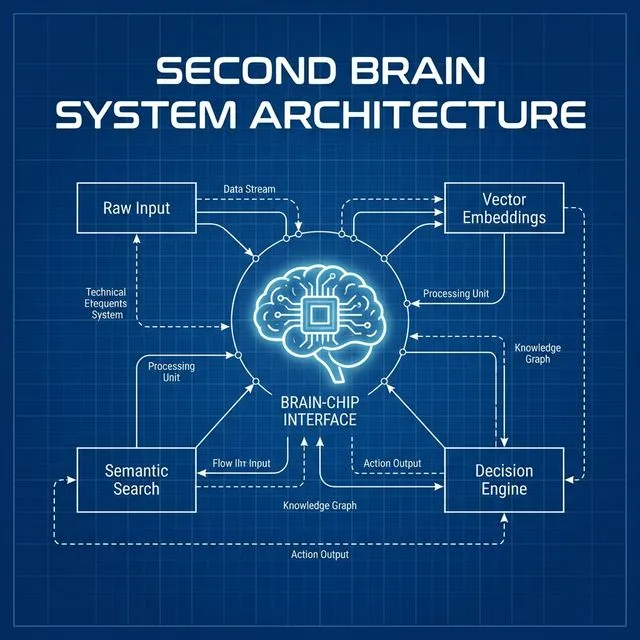
3. Core Protocols
Protocol A: The Evidence Log
Constraint: No "Diary entries". Only structured data.
Entry Schema:
  - Timestamp: ISO-8601
  - Event: "Prioritised Deep Work"
  - Evidence: "Checked email at 08:05 AM (Log #442)"
  - Status: Dissonance Detected 🛑
Outcome: The system flagged a mismatch between intent and reality. It forced an acknowledgment of the failure pattern.
Protocol B: Decision Sparring
Trigger: Before any High-Stakes Conversation (> $1k value or relationship critical).
The Query: SELECT * FROM memories WHERE person = 'Target' AND type = 'Commitment'
Result: Surfaces broken promises or forgotten context *before* the call starts.
4. Curation Heuristics
To prevent "Data Swamp" conditions, the ingestion pipeline applies rigid filters:
⚠️ System Warning: Hallucination Mitigation
Risk: LLM Confabulation.
Mitigation: Strict Citation Requirement. The RAG pipeline must return the source_file_id for every claim. If source_file_id == null, the insight is discarded as noise.
Frequently Asked Questions
What is an AI memory core?
An AI memory core is an externalized evidence store that captures decisions, insights, and experiences in structured data — then makes them semantically searchable. Unlike biological memory, it doesn't decay, drift, or selectively forget. It functions as a "Truth Layer" that decouples memory from ego.
How does vector-based retrieval improve decision making?
Vector-based retrieval uses embeddings to find semantically similar past experiences — not just keyword matches. Before a high-stakes conversation, you can query for all prior commitments, broken promises, or relevant context. This surfaces forgotten evidence that biological memory would have discarded.
What prevents the AI from hallucinating false memories?
A strict citation requirement. The RAG pipeline must return a source_file_id for every claim. If no source exists, the insight is discarded as noise. This creates an auditable chain of evidence rather than AI-generated confabulation.