📊 Implications
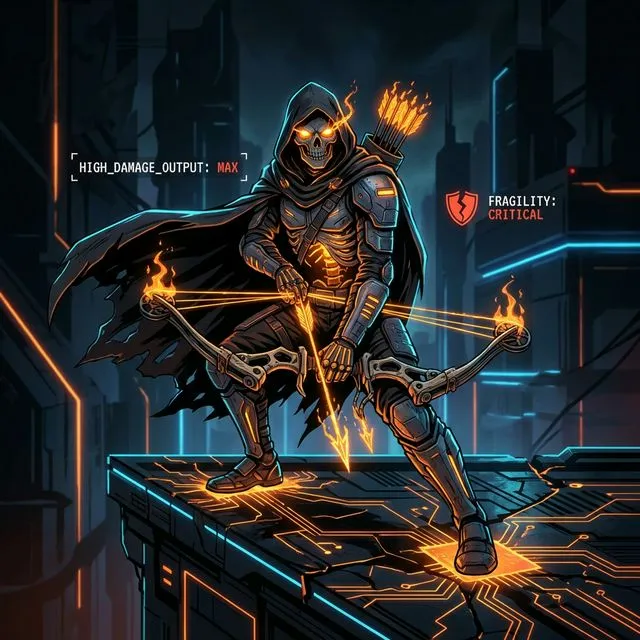
1. Archetype Definition: The Clinkz
Operator Profile: High Output, Low Administrative Durability.
- Primary Stat: Efficiency/Lethality.
- Weakness: Administrative Friction (Aggro). When "Aggro" exceeds 10% of total bandwidth, unit effectiveness drops by 90%.
2. Strategic Topology: The 2-2-1 Formation
To prevent "Feed" conditions (Founder burnout), the operator must outsource 80% of incoming pressure to automated components.
🏗️ Deployment Components
- The Tank (Axe): Zapier/Stripe/Calendly. Absorbs scheduling/invoicing friction.
- The Anchor (Tidehunter): Standardized agreements (Stripe Atlas). Prevents negotiation fatigue.
- The Scout (Nyx): Clay/Instantly. Automated enrichment and outreach.
- The Support (Venge): Custom LLM Agents. Pre-meeting dossier and R&D.
3. Rule: Zero-Positioning Admin
The operator (Carry) should only be visible to the market during Impact Windows (Pitching, Architecture, Writing). At all other times, the unit remains in "Invisibility" (Deep Work), while the Automation Frontline tanks all communication.
📉 Physics of Leverage
Human Carry time = $1,000/hr. Tank/Support time = $0.05/hr (API cost). Failure to adhere to formation results in 20,000x Margin Erosion.
Frequently Asked Questions
What is the Clinkz Doctrine?
It's an operational scaling framework for solo operators, inspired by the Dota 2 archetype. The core insight: high-output individuals ("Glass Cannons") are destroyed by administrative friction. The fix is a 2-2-1 formation — 2 automation tanks, 2 AI scouts, 1 human carry — where 80% of incoming pressure is absorbed by non-human components.
What is the 2-2-1 Formation?
Two Tanks (automation: Zapier/Stripe for sales ops and legal), Two Intelligence units (AI agents for lead gen and research), and One Carry (the human operator for high-value impact). The formation ensures the operator only touches work where human judgment is the bottleneck.
How does this differ from hiring a team?
A traditional team introduces coordination overhead, management tax, and communication latency. The 2-2-1 formation uses APIs and automation ($0.05/hr) instead of humans ($50-150/hr). It's not a team — it's a force multiplier that lets one person operate with team-level throughput at solo-level overhead.