📊 Implications
1. The Shift to Deterministic Output
Problem: "Chat" interfaces encourage vague querying, leading to non-actionable "vibes" based responses.
Solution: Treat the LLM as a Junior Analyst. Do not ask for opinions; assign specific deliverables with defined schemas.
2. The Handshake Protocol
Every task assignment must satisfy the 4-part Handshake before execution begins.
3. The Task Template (JSON-S)
Use this schema for all complex requests. It forces constraint definition.
📄 TEMPLATE: STD-TASK-BRIEF
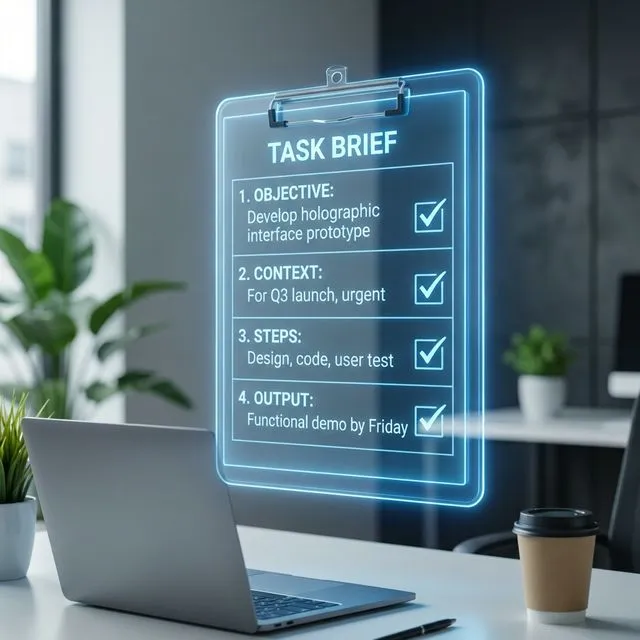
1. OBJECTIVE:
   - [ ] Review Portfolio Copy
   - [ ] Identify 3 weakest claims

2. CONTEXT:
   - Target Audience: Tech Recruiters
   - Tone: Confident, terse, quantitative

3. STEPS:
   - READ input file
   - EXTRACT claims
   - CRITIQUE against "So What?" test
   - REWRITE

4. OUTPUT_FORMAT:
   | Original | Critique | Proposed Rewrite | Metric |

5. QUALITY_BAR:
   - No buzzwords ("passionate", "innovative")
   - Every rewrite must contain a number.
4. Efficiency Metrics
Adopting this protocol resulted in:
- Prompting Time: Reduced from 8m to 3m (Template Reuse).
- Re-roll Rate: Reduced by 60% (Clearer initial constraints).
Frequently Asked Questions
What is the AI Delegation Framework?
It's a structured protocol for assigning deterministic tasks to LLMs. Instead of vague conversational queries, you provide a 4-part "Handshake" — Objective, Context, Output Schema, and Quality Bar — that forces the AI to produce actionable work product instead of generic advice.
What is the difference between "Chat" and "Work Product"?
"Chat" is open-ended conversation that produces opinions. "Work Product" is constrained output with defined deliverables. The shift happens when you specify an Output Schema (JSON, table, checklist) and a Quality Bar (e.g., "no buzzwords," "every claim must contain a number").
How does the Task Template reduce re-rolls?
By defining constraints upfront — tone, audience, format, and rejection criteria — you eliminate the ambiguity that causes bad first outputs. This reduced re-roll rate by 60% and prompting time from 8 to 3 minutes in measured use.