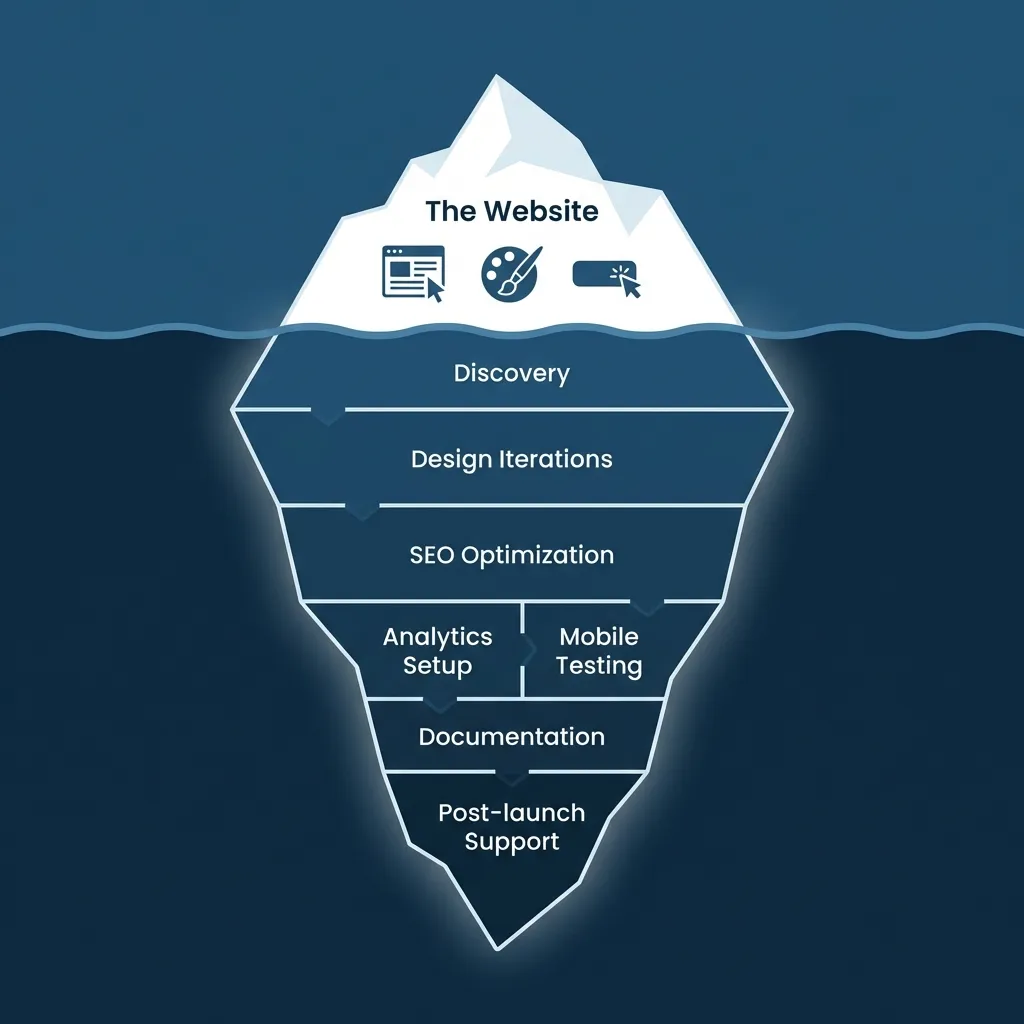
📋 Executive Summary
- The Experiment: I tested market price elasticity by quoting $300 for a 5-page custom website — well below the $1K freelancer floor.
- The Result: They accepted immediately. No negotiation. No pushback.
- The Insight: When cheap is accepted without friction, one side has miscalculated scope.
- The Framework: Brochure Site ≠ Conversion System. Same deliverable name, different product entirely.
📊 Implications
The Floor Test
I wanted to know: how cheap could I price a custom website before the market would say no?
My hypothesis was $500. Below that, surely clients would assume something was wrong — too cheap to be real, or too inexperienced to trust.
I tested $300.
They said yes immediately.
No counter-offer. No questions about what's included. Just: "Great, when can you start?"
That's when I knew the pricing conversation was fundamentally broken.
Table of Contents
Part 1: Where Prices Actually Live
For context, here's where web development pricing actually sits in 2026:
Market Rate Benchmarks
- Template + DIY: $0–$300 (Framer, Squarespace, Wix)
- Offshore Freelancer: $300–$600 (Upwork, Fiverr)
- Local Freelancer: $1,000–$2,000 (custom work)
- Agency: $3,000–$10,000+ (process, team, overhead)
When a client accepts $300 for what they describe as "custom work with a few rounds of revisions," one of two things is true:
- They only need a brochure (template is fine)
- They think they're getting custom work at a 70% discount
Option 2 is where projects die.
Part 2: The Product Mismatch
The core problem isn't price. It's that "5-page website" means completely different things depending on who's speaking.
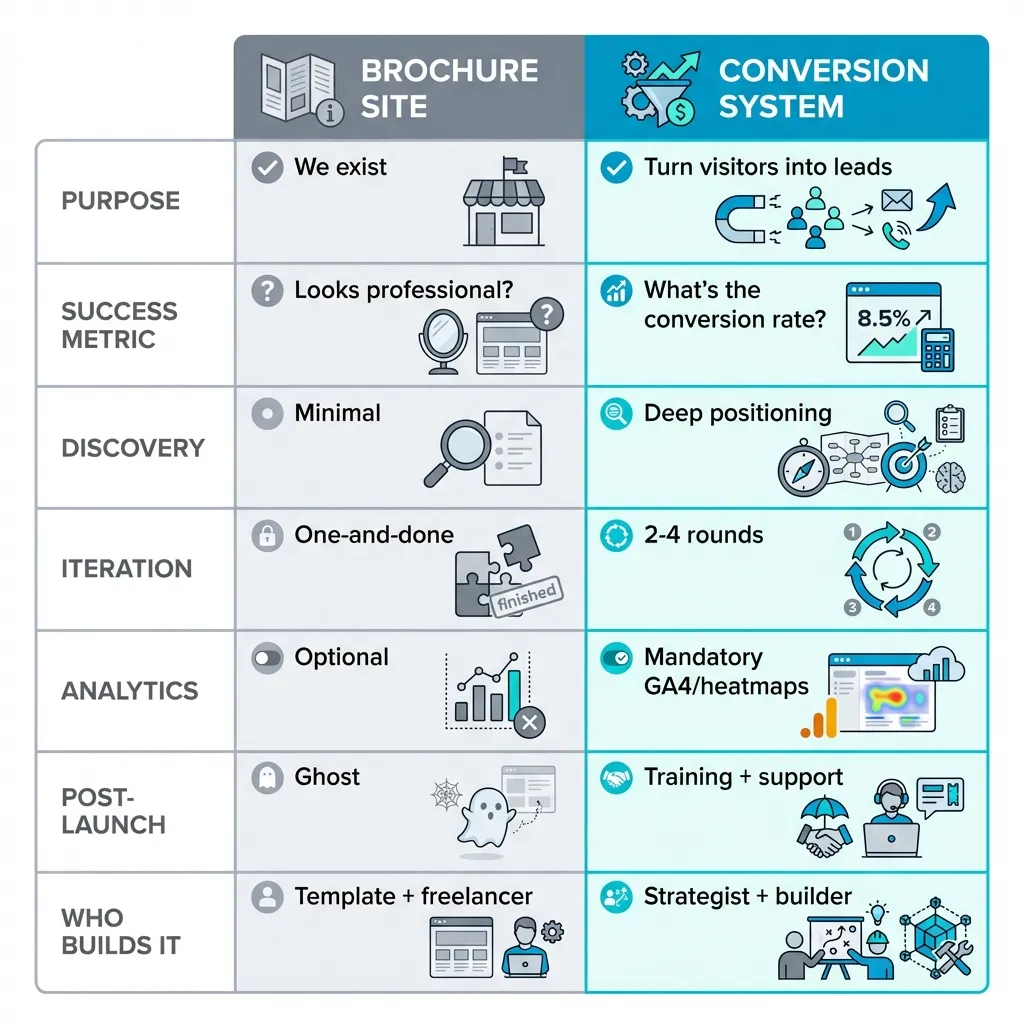
A Brochure Site answers: "Do we exist? Here's our phone number."
A Conversion System answers: "Who visits? What do they do? Are they buying?"
Both are valid. Neither is wrong. But they require completely different levels of work.
Part 3: The Invisible Labour
When I scope a project at $1,500+, here's what the engagement actually includes:
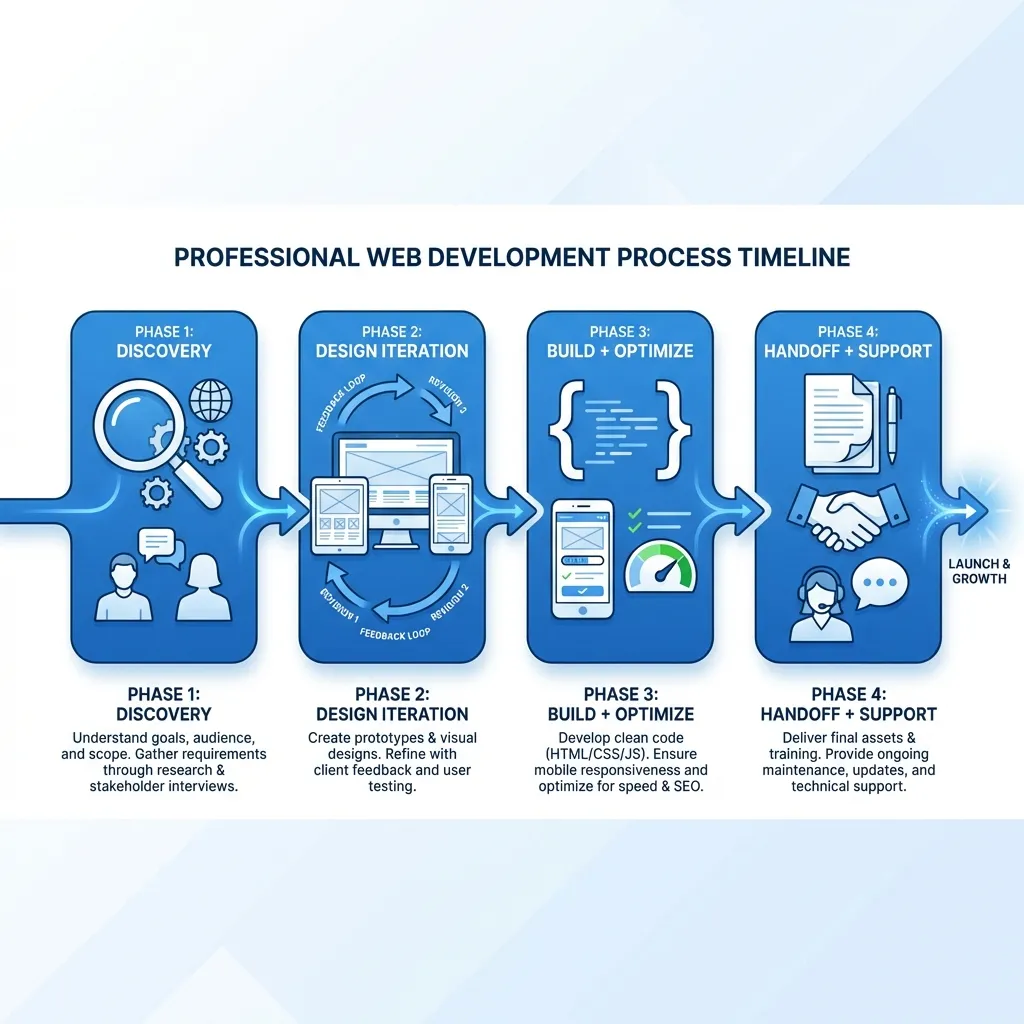
🔍 Phase Breakdown
Discovery: Understanding your business, audience, competitors, and conversion goals. I use a custom AI agent (Gemini GEM) to accelerate this, but synthesis still requires judgment.
Design Iteration: 2–4 rounds of feedback. "I'll know it when I see it" is expensive.
Build + Optimise: Mobile, performance, SEO, analytics. AI generates 80%. Auditing the output is the other 20% — and where cheap builds fail.
Handoff + Support: Documentation, training, CMS setup. If you can't edit your own site, I've built you a liability.
A $300 build skips most of this. That's fine — if both sides know what's being skipped.
Part 4: The Trade-Off Matrix
Neither price point is "wrong." They're different tools for different jobs.
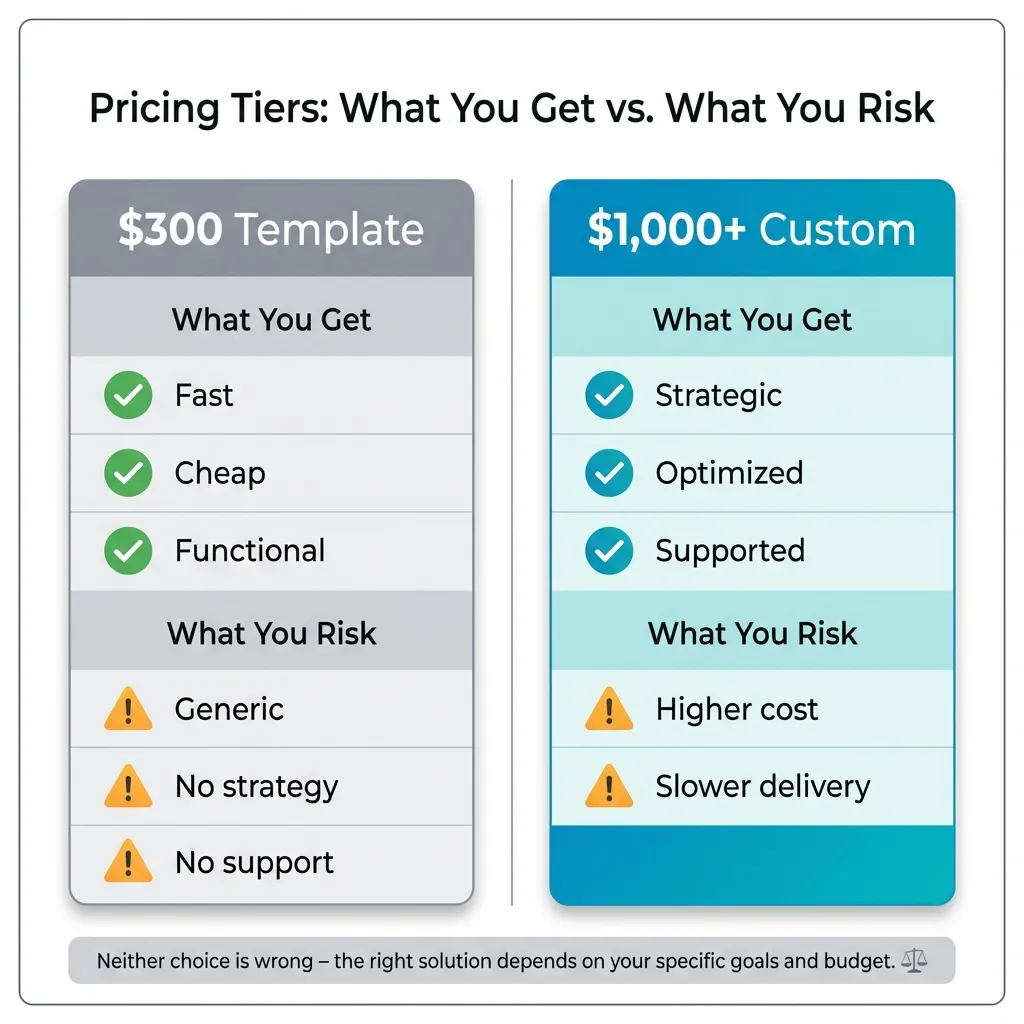
The Decision Questions
- Revenue Driver? If the site should generate leads/sales → Invest in conversion.
- Frequent Updates? If you need to edit content often → Ensure CMS or editable setup.
- Clear Positioning? If you don't know your message yet → Discovery is mandatory.
- Competitive Market? If you're in a crowded space → Differentiation matters.
The Lesson
I didn't take the $300 job.
Not because the client was wrong — they knew what they wanted. But because the scope they described ("custom work, few rounds of revisions, analytics, SEO") was a $1,500 job dressed in $300 language.
The trap isn't the price. The trap is when expectations don't match the investment.
If you're hiring: ask what's included. If you're selling: define what isn't.
📚 Related Reading
- The Vibe Coder's Trap — Why AI speed can't fix business physics
- Case Study: SME Website Build — A 5-page site delivered in under an hour
- How I Built a Gemini GEM Agent — The AI tool that accelerates discovery
A version of this article was originally published on Medium.
Frequently Asked Questions
What is the $300 Website Experiment?
I tested market price elasticity by quoting $300 for a 5-page custom website — well below the ~$1K freelancer floor. The client accepted instantly with zero negotiation. This was the signal that I had miscalculated scope: they expected a brochure, I was building a conversion system. Same word ("website"), different products entirely.
What is the difference between a Brochure Site and a Conversion System?
A Brochure Site is a digital business card: static pages, basic contact form, visual layout. A Conversion System includes SEO architecture, psychological copywriting, lead capture workflows, analytics, and A/B testing infrastructure. The first costs $300. The second costs $3,000+. Most clients don't know the difference until it's too late.
How should freelancers approach pricing?
Price based on the outcome delivered, not the hours worked. A website that generates $50K in leads annually is worth $5K, regardless of whether it took you 10 hours or 100. If you price by the hour, you're penalized for being efficient. Price by the transformation.
See the System
I don't just write about this; I build the systems. Explore the actual codebase behind these insights.
View Athena-Public →Work With Me
Stop drowning in complexity. Hire me to architect your AI systems and bionic workflows.
Book a Consultation →