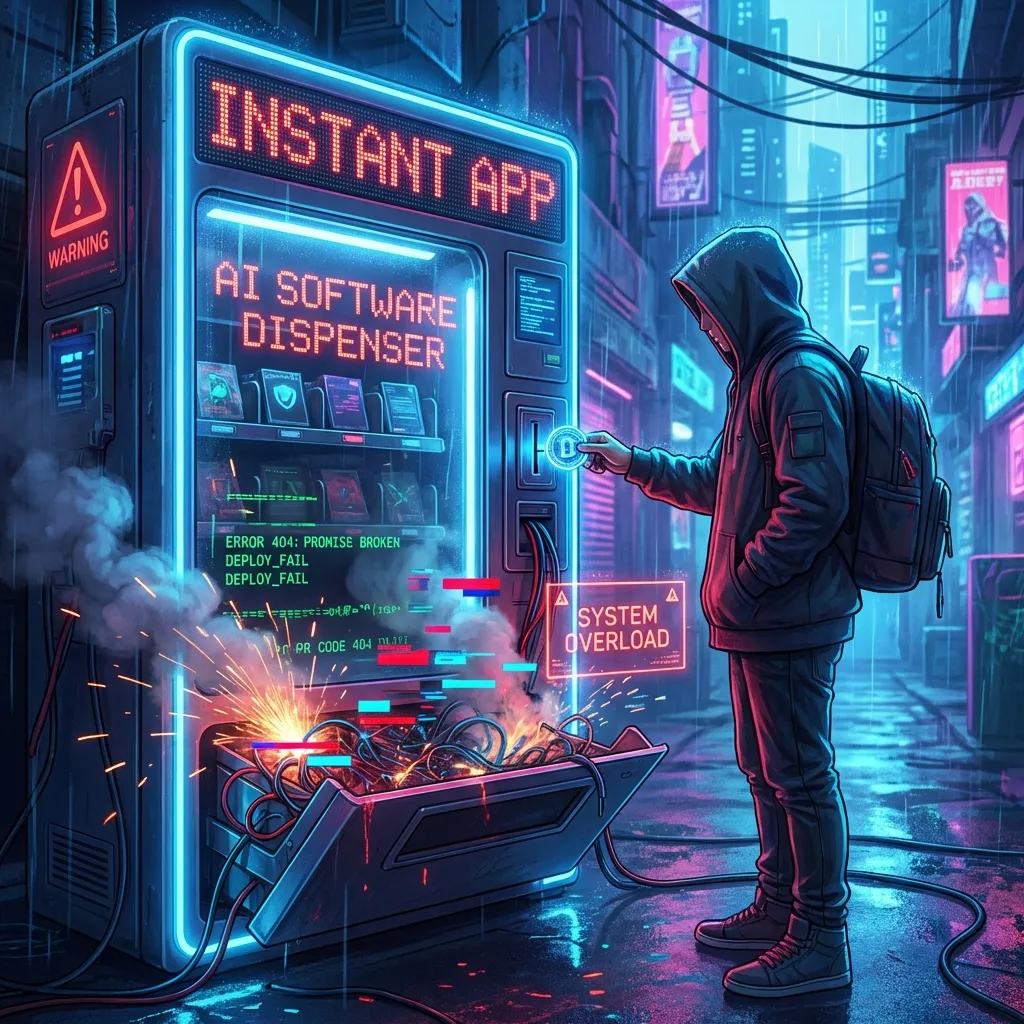
📋 Executive Summary
- The Problem: Clients believe AI makes software development free ("Just use ChatGPT").
- The Reality: A $200 service ("Codingo") delivered a broken, Hallucination-prone app that caused a student to fail his module.
- The Fix: Restoring the project required architectural restructuring, not just code generation.
- The Lesson: You don't pay for the keystrokes. You pay for the 95% of work that happens after the code is generated (Testing, Debugging, Mentorship).
📊 Implications
The "Vendor" Mentality
"Why is this so expensive? Can't you just ask ChatGPT to write the code?"
This is the defining question of 2026. If a model can generate 500 lines of Python in 10 seconds, why does professional engineering still cost hundreds (or thousands) of dollars?
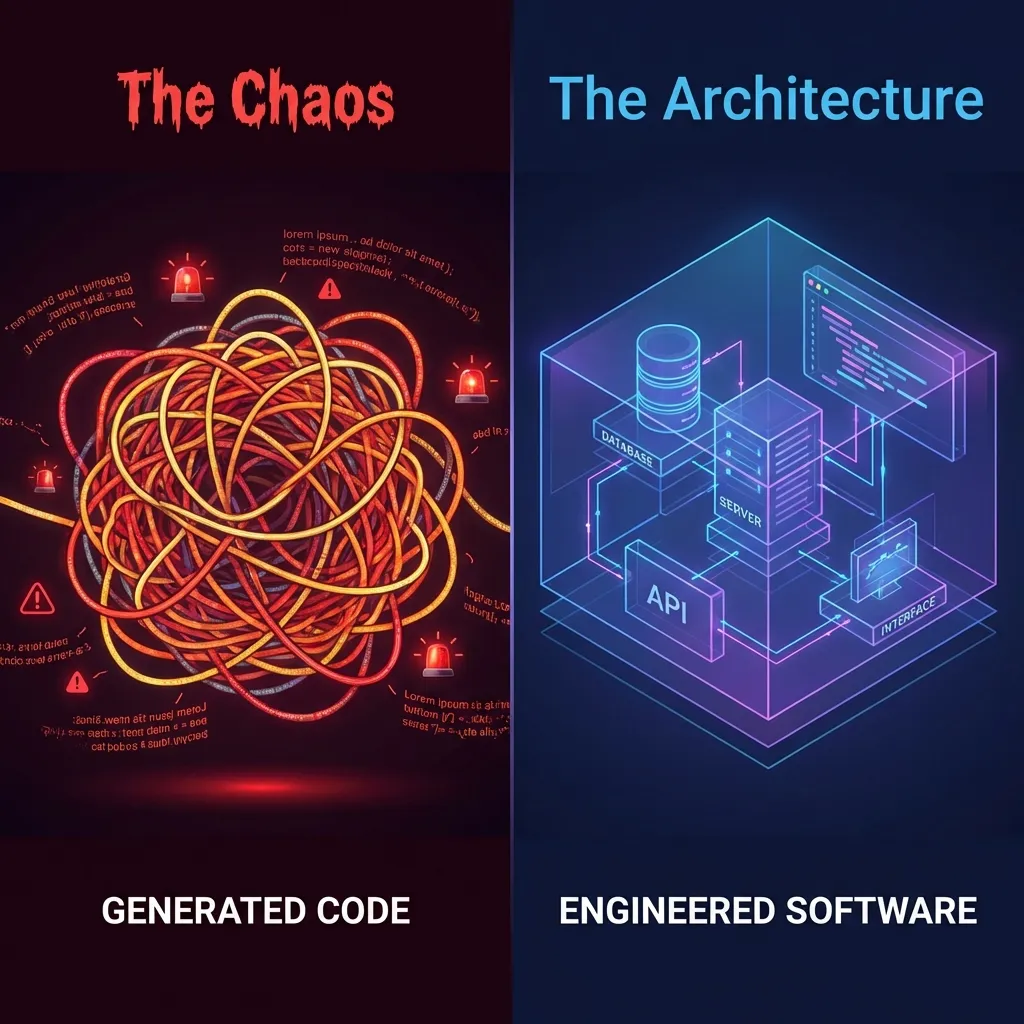
The answer lies in the difference between AI Slop and Engineered Software.
The $200 Disaster
Recently, a client came to me with a web app assignment. He had previously hired a service (let's call them "Codingo") for $200. On paper, it was a steal. In reality, it was a catastrophe.
The code delivered was raw, uncurated LLM output.
- Broken database connections.
- Non-existent security (CSRF vulnerabilities everywhere).
- Fractured logic that collapsed under load.
The client didn't just lose $200. He failed his specific module requirement because the app simply didn't run. The "cheap" option was the most expensive mistake he made.
The Tooling Gap
There is a misconception that developers just "throw files into Gemini UI."
If it were that easy, you wouldn't need me.
Real engineering doesn't happen in a chat window. Professional workflows look like this:
The Professional Stack
- IDE: Cursor / VS Code (not a browser tab).
- Context Engine: Custom RAG systems (like my Project Athena) that inject architectural context.
- Validation: Automated testing and security scanning.
Project Athena isn't just a wrapper. It's a private repository that condenses hundreds of hours of my coding patterns. When I generate a draft, it starts at 80% quality, not the 40% you get from a public web chat.
The 95% Included in the Price
Even with my advanced tooling, generation is only 5% of the job.
For this specific "simple" $400 rescue mission, I spent the entire night in the trenches.
🔍 The Iteration Cycle
Testing: Confident AI makes confident mistakes. Every route was manually verified.
Debugging: Looking for invisible logic errors, race conditions, and state management bugs.
UX Polish: "Make it pretty" is a bad prompt. Design principles are a discipline.
Security: Adding the CSRF tokens and input validation that the AI forgot.
This is the invisible labor. The client doesn't see the 4 hours I spent fixing a session management bug; they only see that "it works."
The Real Product: Competence Transfer
Finally, there's the After-Support.
My service isn't just "here's the zip file, good luck." It includes the mentorship required to actually use the software.
- "How do I run this locally?"
- "Why is the database structured this way?"
- "How do I explain this function?"
I had to ensure the client understood the code well enough to defend it. If I had just dumped the files (like the $200 vendor did), he would have been helpless.
Fair Value
To the client, $600 felt expensive compared to $200.
But the $200 option was a liability. The $600 option was an asset.

In the age of AI, you aren't paying for keystrokes. You're paying for the expertise to know which keystrokes matter when the autopilot disconnects.
📚 Related Reading
- The $300 Website Experiment — Another lesson in pricing vs value.
- Project Athena — The system behind the workflow.
This article was originally published on Medium.
Frequently Asked Questions
Why is $200 development work often worse than doing nothing?
Because it creates a false foundation. A $200 coder using AI copy-paste can generate a working demo, but the code lacks error handling, testing, and architectural integrity. When it breaks (and it will), debugging someone else's hallucinated code is harder than building from scratch. You pay twice: once for the broken version, once for the fix.
What should I look for when hiring a developer?
Three things: (1) Do they ask questions about edge cases before writing code? (2) Do they include testing and documentation in their scope? (3) Do they explain their architecture decisions? If the answer to any of these is no, you're hiring a prompt-and-paste operator, not an engineer.
What is the difference between code generation and software engineering?
Code generation produces syntax. Software engineering produces systems. The difference is everything that happens after the first "working" version: handling edge cases, writing tests, structuring for maintainability, debugging under production conditions, and communicating architectural decisions to stakeholders.
See the System
I don't just write about this; I build the systems. Explore the actual codebase behind these insights.
View Athena-Public →Work With Me
Stop drowning in complexity. Hire me to architect your AI systems and bionic workflows.
Book a Consultation →